
| Works Eduardo González Viaña
|
|
| Vallejo en los infiernos (Alfaqueque Ediciones, Spain, October 2008) Between November 1920 and March 1921 the renowned Peruvian poet César Vallejo was imprisoned in Trujillo public jail, accused of instigating an attack in his home town of Santiago de Chuco, which led to three deaths, a fire and looting.Bribed by the poet’s enemies, the judge in charge of the investigation forged signatures and documents. The police extracted a signed confession, under torture, from one of the actual perpetrators of the crime even though he was illiterate. With the mountain of evidence piled against him, the author of España, aparta de mí ese cáliz, who was 28 years old at the time, was to be held for an unlimited length of time in a prison which inmates only left feet first or raving mad. Not only does González Viaña tell the story of the four months the poet spent in Trujillo prison and the accompanying legal wrangles, he skilfully winds in and out of Vallejo’s life, from childhood until his death in Paris. Avoiding a boring chronological order, he describes the extraordinary characters he came across (friends, lovers and fellow prisoners) and those who tried to snatch his life from him. A poet accursed, poor yet elegant, a Christian committed to the syndicalist struggle, Vallejo was involved in the creation of the first socialist party in a country that was reactionary, racist and corrupt. Almost visual in quality – it would make wonderful material for a film – many of the scenes depicted in the novel remain etched in the reader’s eye. Combining literary sensitivity with a meticulous search for numerous details of Vallejo’s life in the legal records of the time, the unpublished diary of his beloved Maria Sandoval and the revelations of his other sweetheart, Zoila Rosa Cuadra, who lived until 2000, Eduardo González Viaña has managed to penetrate the very soul of the poet. César Vallejo’s poems have been translated into every language imaginable. Millions of copies of his works have been published, but not one single biographical novel has been written. This is the first. Foreign Rights sold to:
|
|
El corrido de Dante In this novel González Viaña tells the metaphoric tale of Latin American immigration to the United States. Dante, the central character, is a Mexican who travels across the country in a ramshackle van with a donkey called Virgil for company. Virgil listens quietly unperturbed as Dante reminisces about his arrival in the United States and his blissful love for Beatriz, now dead. Spanish is the language spoken throughout Dante’s odyssey across the United States where he encounters a string of eccentric characters like the Noble Couple, who read horoscopes on the radio and sell amulets, or Juan Pablo, a computer whizz-kid who uses his know-how to rob a casino in Las Vegas and pay his way through university. Fate and dire need make him form a balladeer duo with The Pilgrim, a singer who’s crossed the border so many times through underground tunnels that the damp, death-like smell of the soil still clings to his skin. The novel bustles with many other characters, including an old shepherd who has his own peculiar conception of society as a huge horse corral – even Adam and Eve fit into his view of things –where Latinos are a wonder of a breed. Moving from surprise to surprise, the novel comes to an amazing end, revealing in the process an unknown face of the United States “where people already dream in Spanish, do business in a little English, dance in Portuñol and switch back to Spanish for lovemaking”, to echo the words of Alberto Ruy-Sánchez when reviewing the novel. Foreign Rights sold to:
|
|
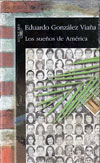 |
Los sueños de América (Alfaguara, Peru, 2000) The majority of the short stories in this collection are a symbol of the phenomenon of Hispanic migration to the United States. The opening story tells the tale of a family who, unable to bring themselves to leave their donkey Porfirio behind, attempt to cross the border with donkey and all, managing to dodge the patrols. Another story tells of a Cuban woman in her eighties who sets off from Havana to reach the United States in a raft, but she’s no ordinary balsera. All she takes with her is an image of Saint Barbara to avert the perils of a storm which threatens to destroy Florida and the business of her beloved son, Ivan. “A magnificent testimony of the Latin American presence in the United States.” “The prose is so perfect that one wants to sing while one reads it.” Alfredo Bryce Echenique
Foreign Rights sold to: Arte Público Press (USA), American Dreams ,2005
|
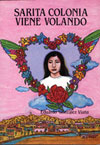 |
Sarita Colonia viene volando Sarita Colonia is a saint begot of necessity, a saint born of the hopes and kindled by the imagination of the poorest of Peru. A flesh-and-blood saint (1924–1940) who twenty years after her death started to attract devotees amongst the more underprivileged strata of Peruvian society: the jobless, street vendors, prostitutes, petty thieves. In the 1990s, her following spread to the Latin Americans who cross the border illegally into the United States. Eduardo González Viaña has crafted an imagined biography from the testimony and dreams of her devotees. In the book, Sarita Colonia, who died fifty years ago, comes back to life. As she flies across the skies of Peru, fantasy knows no limits: two women whisper under the water, a dead man sings, roses turn into ghosts and the solar system threatens to vanish. Reality knows no limits either: in an underground sky, the sky of the poor, the saint converses with the missing and the denizens of communal graves. Illegal immigrants usually carry a scapular sown into the seams of their clothes containing a holy picture of Sarita. Some now also carry a photo of the cover of the book, which was published in Peru (1990).
|
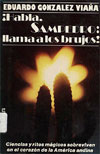 |
¡Habla Sampedro: llama a los brujos! ¡Habla sampedro: llama a los brujos! is the testimony of a conversation between the author and a blithe shaman in a peaceful village of Peru. The real-life character of the book, Eduardo Calderón Palomino, aka El Tuno (The Rascal), is the father of a bevy of kids, shaman, pottery maker, fisherman, wise man and wag all rolled into one. El Tuno lives on a magical plane where, with surprising clarity, he pulls apart stock concepts, revealing an awesome world without resorting to phantasmagoria or cheap tricks. A father of fourteen and connoisseur of chicha, the traditional drink of Peru, El Tuno cooks fish and shellfish to a perfection that would be the envy of top chefs. But he’s no holy man, far from it. As he tells the author, he’s too poor to be an ascetic. El sampedro, the mescaline cactus whose Spanish name is Saint Peter because “it has the keys to heaven”, is a cactus found extensively in the deserts of Peru. The native shamans use its hallucinatory properties to see at a distance, to travel from one place to another without moving, to heal the sick, to break the will of the absent and to entangle and disentangle affairs of the heart. El Tuno talks to the sampedro and gives readers the recipe to make it.
|
|
|
|
|